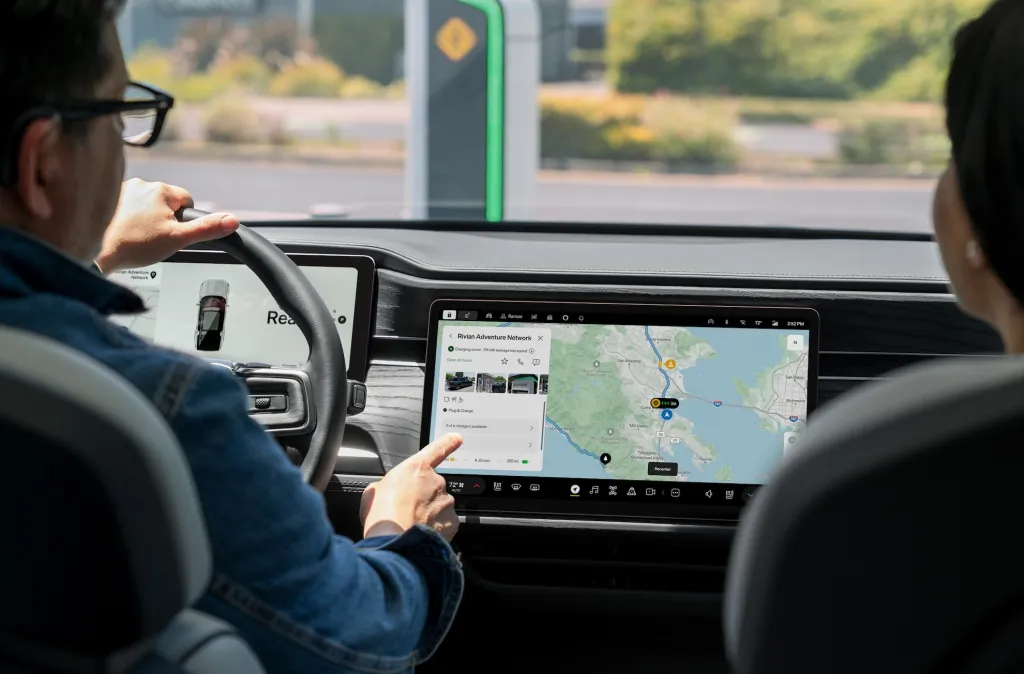
Rivian has spent nearly two years building its own Rivian AI assistant—a deep, in-house effort that remains entirely separate from its $5.8 billion technology joint venture with Volkswagen. For now, the company has not announced a public launch date. However, earlier this year, Rivian’s software chief Wassym Bensaid told TechCrunch the team was targeting the end of 2025. As a result, more details are expected during Rivian’s AI & Autonomy Day, which will livestream on December 11 at 9 a.m. PT.
This move reflects a broader industry trend. While foundational AI companies like Google, Microsoft, OpenAI, and Anthropic accelerate development, automakers are racing to embed intelligent systems into their vehicles. But Rivian’s approach is not a rushed response to trends. In fact, Bensaid emphasized it is not just a chatbot dropped into an infotainment screen. Instead, the company designed the assistant to integrate fully with all vehicle controls—from climate settings to safety systems.
From the very beginning, Rivian adopted a model-agnostic philosophy. Consequently, the team in Palo Alto built an architecture that can work with multiple AI models. Early on, they realized success depended not just on the models themselves, but also on the software layers that manage workflows and resolve control conflicts.
“And that’s the in-vehicle platform we have built,” Bensaid explained. “We use what the industry now calls an agentic framework—yet we designed that architecture from day one.”
This in-house AI effort aligns with Rivian’s broader push toward vertical integration. In 2024, the company completely overhauled its R1T truck and R1S SUV. Specifically, it redesigned the battery, suspension, sensor suite, electrical architecture, and user interface—all to support next-generation software.
Moreover, Rivian invested heavily in its full software stack. This includes real-time operating systems (RTOS) that manage critical functions like thermal dynamics, ADAS, and safety protocols. It also covers the infotainment layer—now enhanced with AI capabilities.
According to Bensaid, the Rivian AI assistant uses a hybrid approach. On one hand, it leverages edge AI—processing tasks directly inside the vehicle. On the other hand, it taps cloud AI for heavier computational work handled by remote servers. Therefore, this split ensures speed, privacy, and flexibility.
Notably, the company built much of this stack itself. For example, it developed custom AI models and what Bensaid calls the “orchestration layer.” This layer acts like a conductor, ensuring all AI components collaborate smoothly. That said, Rivian did partner with external specialists for certain agentic functions—though the core remains fully proprietary.
Ultimately, the goal is to create an AI assistant that builds customer trust and deepens engagement. “It’s about making the vehicle feel like a true partner,” Bensaid said.
Importantly, this AI project stays within Rivian. By contrast, the Volkswagen joint venture—launched in November 2024—focuses only on electrical architecture, zonal compute, and infotainment software. It will power future Volkswagen Group vehicles starting in 2027. But it does not include AI assistants or autonomous driving systems.
That said, Bensaid left the door open for future collaboration. “Autonomy and AI are separate for now,” he noted, “but it doesn’t mean they won’t converge later.”
As Rivian prepares to unveil more on December 11, the Rivian AI assistant stands as a bold statement: the future of electric vehicles isn’t just about batteries and motors. Rather, it’s about intelligence, seamless integration, and driver-centric control—all built from the ground up.
READ: Waymo for Business: Revolutionizing Corporate Travel with AI-Powered Robotaxis