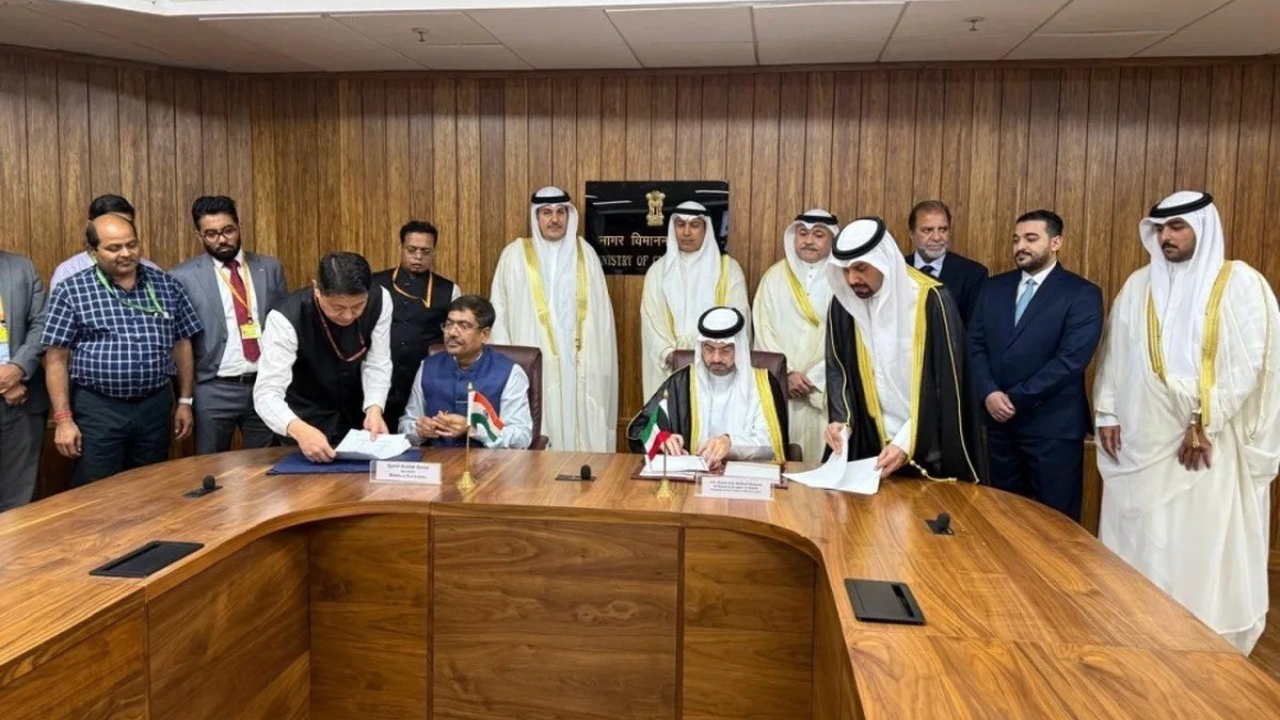
In a major policy shift, India Kuwait air rights have been raised to 18,000 weekly seats—a 50% increase from the earlier limit of 12,000. This marks the first bilateral enhancement for Kuwait in 18 years. The new agreement was signed between India’s aviation secretary Samir Kumar Sinha and Sheikh Hamoud Al-Mubarak, president of Kuwait’s Directorate General of Civil Aviation.
Both countries had already exhausted their earlier quota, with carriers pushing for expanded capacity. With the updated pact, airlines from both sides can now offer 18,000 seats weekly. Currently, India and Kuwait support nearly 40 daily flights. Kuwait Airways leads with 54 weekly flights, while IndiGo follows with 36. Other carriers like Air India Express, Akasa Air, and Jazeera Airways also maintain regular services.
Kuwait had long pushed for this boost, mirroring similar requests from other Gulf countries. Dubai and other Middle East destinations continue to see rising demand from Indian travelers. This move reflects India’s wider regional strategy to expand global connectivity while protecting national airline interests.
Over the past year, India has signed new air service agreements with Vietnam, Thailand, Indonesia, and Uzbekistan. The current raise in India Kuwait air rights adds another key update to its international aviation portfolio.
Since 2014, the Modi government has adopted a cautious but strategic bilateral air policy. It focuses on supporting Indian carriers in gaining international market share. Several steps underpin this strategy. These include heavy investment in Indian airports to make them global hubs, the disinvestment of Air India and Air India Express, and policy support for new private airlines like Akasa. Despite supply chain challenges, the government has helped IndiGo expand operations and hold its market lead.
The increase in seats to Kuwait will help meet rising passenger demand while also offering Indian carriers more flexibility. This also enables airlines to serve tier-2 cities in both countries more effectively. In turn, it could ease pressure on busy hubs like Delhi and Mumbai by spreading traffic more evenly across the network.
This development signals India’s willingness to balance protection of domestic airlines with evolving global demand. By expanding India Kuwait air rights, the aviation ministry has taken a step that benefits travelers, airline operators, and regional trade connectivity.